About this blog...

Friday, 12 August 2016

Donald Trump's Roman predecessor


The multi-millionaire businessman is holding a lavish dinner party at his luxury home. He returns to the table after a lengthy visit to the restroom:
Folks – excuse me folks! – my bowels have been a little low-energy these last couple days. Doctors, all the doctors, did their thing, couldn’t find a cure. But I invented my own medicine! I’m a smart person, really smart. Otherwise my stomach, it’d be growling like a bull for sure. A bull! So lemme just tell you, if any of you people gotta, you know, go, just, like, go.  No need to be embarrassed, folks. Just do it! We all get gas. Let me tell you, there’s nothing worse than keeping it in. And the Lord God Almighty would agree with me on that one. Seriously. Even if you gotta pass gas during dinner, go right ahead, I won’t stop you! I have the best doctors, that say don’t, don’t hold it in. Very unhealthy! If you need to take a dump, though, you can go outside to the restroom! But gas, it rises up to your brain and then infects the rest of your body. Believe me. I personally have known people, many, many people that died because they didn’t take that advice. Sad!
Remind you of anyone?
This is a loose translation of the words of Trimalchio, the great comic character in Petronius’ 1st Century CE Roman novel known as The Satyricon. Returning recently to the Cena Trimalchionis (Trimalchio’s Dinner Party) episode, I was struck by the similarities between Trimalchio and a certain candidate for Leadership of the Free World. This ignorant buffoon (Trimalchio, that is) has come from humbler origins, though: he is a libertus, a freedman or former slave; his Semitic name suggests that his family came to Italy from the Middle East. Likewise, Donald Trump’s name betrays his own immigrant origins, his family having sailed west from Scotland (we’re sorry about that, world).
Trimalchio is vulgar, rude, crude, boorish, boastful, ostentatious and completely devoid of taste. He is also fabulously wealthy, having made his money in import/exports: I was once like you guys, he tells his guests, but I was tough enough to get where I am now. Guts is what you need, the rest is bullshit. Buy low, sell high, that’s my motto. (Satyricon 75)
Fellini's Satyricon

He is not deliberately insulting his guests; he simply lacks empathy or any capacity to weigh the effect of his words on the sensitivities of his audience.  Indeed, earlier in the night he has unwittingly offended his friends while, to his mind, he is showing them respect:
verum Opinianum praesto. heri non tam bonum posui, et multos honestiores cenabant.
This is the finest vintage wine you’re drinking. I didn’t serve such good wine last night, and the guests were much higher class. (Sat. 34)
Occasionally there is flash of genuine wit in Trimalchio’s table talk, but even then it is put in the service of self-aggrandisement. When a guest begins a story with the words, there was once a poor man and a rich man… Trimalchio interrupts: quid est pauper? What’s a poor man?
Another trait shared by Trump and Trimalchio is their insistence on emphasising that what they are telling you is the truth: believe me is a favourite phrase of both:
Credite mihi, assem habeas, assem valeas
Believe me, if a penny is all you’ve got, a penny is all you’re worth (Sat. 77).
A variation of this assertion of truth is scis tu me non mentiri (you know I’m not lying) from Trimalchio; there will be no lies from Trump at the RNC. I will leave it to the reader to consider why trustworthy characters would feel the need to remind their audiences of their honesty quite as often as they do; a kind psychologist might interpret it as evidence of an inferiority complex, the certainty of their opinions being over-compensation for deep ignorance. Trimalchio talks about his antique collection: I’m the only guy on earth that owns genuine Corinthian plate…I’m not an ignoramus, I know that Corinthian metal was invented when that slippery customer Hannibal captured Troy… (Sat. 50)
He is apparently unaware that this is a complete mishmash of Roman history and Greek legend, just as Trump is sure there are no Russians in Ukraine.
Trump’s own ignorance apparently includes a belief in superstitions. He is said to throw salt over his shoulder at meals, and believes in lucky golf balls. It is not known if he believes in astrology, as Trimalchio certainly does. He explains the various traits of the Signs of the Zodiac to his guests: I was born under Cancer the Crab, so I have lots of legs to stand on, and many possessions on land and sea, for either one suits a crab. Incidentally, The Donald was born under Gemini: Trimalchio explains that the sign of the Heavenly Twins is associated with a pair of horses, two yolked oxen, people who want it both ways, and guys with big bollocks (Sat. 39).
And on that subject, rather than further desperate hammering of the relevance of Latin literature to current issues, let us now break for a short quiz on the sexual boasts and creepiness of our two heroes. Quaero: who said the following, Trump or Trimalchio?
1.  If I told the real stories of my experiences with women, often seemingly very happily married and important women…
2.  I always succeeded in getting my mistress off – you all know what I mean. I’ll say no more because I don’t wanna boast.
3.  You should see my wife dance – believe me, nobody knows her way round a pole like she does. 
4.  Don’t you think my daughter’s hot? She’s hot, right?
Check your answers at the end.
We have probably had quite enough points of comparison between Trimalchio and the GOP's unlikely candidate. What of the differences? Well, apart from the fact that they are jokes separated by 2000 years, it strikes me that Trimalchio, for all he is a buffoon, never makes a deliberately racist comment. Oh, and unlike Trump, Trimalchio is bald…
Any readers who care about the avowed intent of this blog will by this time be thinking, is this not just an opportunity for a cheap shot at an easy target? What happened to the bit about “classical references in modern literature”?
Well, before that, an interesting story about the author of the Satyricon, Gaius (or maybe Titus) Petronius. Our Petronius was arbiter elegantiae, or style consultant and confidant, to the emperor Nero; he may well also have been a consul in 62 CE. Unfortunately, he got on the wrong side of Tigellinus, prefect of Nero’s Praetorian Guard, and was obliged to commit suicide after being threatened with arrest on trumped-up charges of treason.
Makovsky, Death of Petronius
The historian Tacitus relates that Petronius attempted to plead his case in person to Nero, who was on a visit to Campania. Petronius got no further than Cumae, where he realised that the game was up. Rather than get his death over with quickly, however, Petronius decided rather to check out in his own good time and on his own terms. He invited some friends round, then opened his veins, but would bandage them up again if the conversation seemed to be getting interesting. He then had dinner, rewarded some of his slaves and ordered that others be flogged. Before he died, he composed a full account of Nero’s sexual activities, together with a list of his male and female partners, which he then sent to the Emperor.
But to return to Petronius’ modern literary connections. Our own comparison with Trump is not the first time Trimalchio has been associated with an ostentatious nouveau riche American. F Scott Fitzgerald’s draft titles for The Great Gatsby included Trimalchio and Trimalchio in West Egg. He was eventually persuaded that the reference was too obscure for the reading public; but apparently he later regretted dumbing the title down. If he had stuck to his guns, might we have seen Baz Luhrmann’s  Trimalchio starring Leonardo DiCaprio, I wonder?

Trimalchio’s best known appearance in modern literature, however, is as the speaker in the epigraph of the most important poem in 20th Century English literature: TS Eliot’s The Waste Land.
“Nam Sibyllam quidem Cumis ego ipse oculis meis vidi
in ampulla pendere, et cum illi pueri dicerent: Σιβυλλα
τι θελεις; respondebat illa: αποθανειν θελω.”
In actual fact I saw the Sibyl at Cumae with my own eyes hanging in a bottle, and when the boys said to her, Sibyl, what do you want? She would reply: I want to die (Sat. 48).
There were a number of Sibyls, or female prophets, in antiquity. The most important to the Romans was the Sibyl of Cumae, whom Trimalchio here drunkenly claims to have met. The story is that the god Apollo fell in lust with her, and offered to grant her any wish in return for her favour. She asked to live for as many years as the grains of sand she held in her hand; but unfortunately neglected to request eternal youth and health to go along with her long life. Accordingly, as she got older she withered away physically to such an extent that she could be kept inside a bottle; in the end, only her voice remained. It’s an odd coincidence that Cumae, where the world-weary Sibyl couldn’t die, is the same place Petronius chose to end his own life.
So what is the relevance of the epigraph to The Waste Land? Does the poet see himself (or his persona) as a weary prophet, waiting for death? More about prophecy and The Waste Land in the next post. 


Chiasmic quiz solution: 1. Trump, 2. Trimalchio (Sat. 75), 3. Trimalchio (Sat. 52), 4. Trump.

Monday, 25 July 2016

Wheels within wheels


Fortuna, Ixion and King Lear
In the last post we visited Tartarus, the classical hell, and met a few of its inhabitants: notably Ixion, former king of the Lapiths in Thessaly. Readers will recall that Ixion’s big mistake was to abuse the hospitality of Zeus by attempting to seduce his wife, Hera. His lustful intentions were however discovered, and Ixion was tricked by Zeus into having sex with a cloud instead. The cloud later gave birth to the race of the centaurs; Ixion was punished for his hubris by being bound to a revolving wheel of fire in Tartarus.
Why this form of punishment specifically? Some commentators see in the wheel of Ixion the vestiges of a more ancient sun-god myth; others, including Robert Graves, suggest that the fire was a later addition, and put more emphasis on the crucifixion aspect of Ixion’s torture. Some suggest that the wheel is symbolic of the eternal nature of his punishment.
Across centuries and cultures, wheels have symbolised destructive power, whether they are attached to a mighty Juggernaut or are little and green; the most common allusion to the wheel in medieval and early modern literature, however, is in the form of The Wheel of Fortune, or Rota Fortunae. It is an allegory of the inexorable workings of fate, a metaphor which explains in simple terms the vicissitudes of the human condition: you may be a king today, but tomorrow you could find yourself on a storm-lashed heath without a crown or even an umbrella. As the cowboy said, sometimes you eat the bear, and sometimes the bear eats you. The goddess Fortuna sometimes gives the wheel a bit of a spin, changing your luck for better or worse. When, in King Lear, Kent finds himself humiliatingly condemned to the stocks, he calls upon Fortune to Smile once more. Turn thy wheel… (Lear II, 2, 167).
Fortuna has traditionally been personified as a fickle woman: from comparison with the inconstant moon in Carmina Burana’s O Fortuna velut luna; to Frank Loesser’s Luck be a Lady: A lady doesn’t wander all over the room/ and blow on another guy’s dice. In Macbeth, Fortune is described as acting like a rebel’s whore; in Antony and Cleopatra she is a false housewife; in Hamlet, she is a strumpet, and the subject of a somewhat contrived dirty joke: on being asked how they are doing, Rosencrantz and Guildenstern tell Hamlet that they are neither at the top of Fortune’s cap, nor at her shoes. When Hamlet obligingly offers the feed line: Then you live about her waist, or in the middle of her favours? Guildenstern delivers the punchline, Faith, her privates we, doubtless thinking back of the net.
Back in Lear, the revolving wheel is obvious in the relationship of the half-brothers Edgar and Edmund: at the beginning of the play, the illegitimate son Edmund is aggrieved at his comparatively low status and the obvious contempt of his father, Gloucester; he contrives the exile of his legitimate brother and the downfall of his father, with the aim of inheriting his wealth and power. Edmund is now at the zenith, and Edgar at his nadir: Fortune spins once more, however, and when Edmund is mortally wounded by his brother, he accepts that the wheel is come full circle (Lear V, iii, 203).
Fortune, the stars and the gods are all at one time or another blamed for the ups and downs of the characters: Gloucester complains that as flies to wanton boys are we to the gods;/They kill us for their sport (IV, I, 36f); Kent that stars above us govern our conditions (IV, iii,33). But the villainous Edmund can see that this is so much nonsense. In a soliloquy, he mocks his father’s astrological explanation of Lear’s foolish behaviour towards Cordelia and Kent (I, ii, 118-135), clinching the argument with reference to his own nature: I should have been that I am had the maidenliest star in the firmament twinkled on my bastardizing.
There is a tension here, and elsewhere in Shakespeare, between external and internal influence, between the workings of fate and personal responsibility. As Cassius remarks in Julius Caesar, The fault, dear Brutus, is not in the stars/ but in ourselves… (I,ii,140f). Human agency, rather than Dame Fortune, brings about the downfall of both Gloucester and Lear: a downfall which has its origins in their own flawed characters and actions.
So when in Act IV Lear declares to Cordelia: Thou art a soul in bliss; but I am bound/ Upon a wheel of fire that mine own tears/ Do scald like molten lead (IV, vii 46-48) the wheel imagery is not so much (or not only) an allusion to the Wheel of Fortune, but to the punishment of Ixion. Lear recognises that the hell in which he finds himself is not a temporary downward turn, but eternal punishment for his own folly: his only consolation is that Cordelia is not in Tartarus with him.
This is not the only allusion to the story of Ixion in King Lear: earlier (IV, vi, 124-125) he describes his other daughters thus: down from the waist they are centaurs/ Though women all above.  
As we have seen, Ixion was the progenitor of the centaurs, who developed a reputation for bad sexual etiquette, such as the attempted rape of the bride at their cousin’s wedding. They symbolise the untamed, incontinent beast literally underlying civilised and domesticated humanity, and in the case of Regan and Goneril, what Shakespeare sees as a most unladylike lust, ruthlessness and ambition. Lear is explicit about the location of good and evil in women:
But to the girdle do the gods inherit,/ Beneath is all the fiends’ (IV,vi, 127-8)
The sexism of these expected gender roles is of its time; the misogyny of the language of King Lear is something else altogether, however.  From the opening scene where Gloucester asks Kent, Do you smell a fault?  in reference to the circumstances of Edmund’s conception, there is a queasy insistence on associating foul odour and burning pain with women, or more precisely, their genitalia, culminating in the extremes of
There’s hell, there’s darkness, there is the sulphurous pit, Burning, scalding stench, consumption… (IV, vi, 129f)
Some critics see in this language a description of a sexually transmitted infection: D H Lawrence for one attributed Shakespeare’s misogynistic language in Lear and other works to the “shock of his consciousness of syphilis”; Anthony Burgess in the fictional biography Nothing Like the Sun came to a similar conclusion.  When Edgar tells Edmund: The gods are just, and of our pleasant vices/ make instruments to plague us:/ The dark and vicious place where thee he got/Cost him his eyes (V, iii, 170-3) he is making the point that their father Gloucester’s sexual desires have resulted in his destruction.
Lear too, though his daughters were got ‘tween lawful sheets, is being punished for the sexual activity that created them. In his fevered mind, women are promiscuous temptresses, men are hypocritical slaves of lust, deserving of painful retribution: Why dost thou lash that whore? Strip thine own back;/ Thou hotly lusts to use her in that kind/ For which thou whipp’st her (IV, vi, 161-3). 
We cannot now know whether the misogyny of Lear’s language is rooted in Shakespeare’s self-disgust, or derived from a (highly unlikely) late conversion to Puritanism/Calvinism, or indeed is purely character-driven, without any resonance in his own life; but for whatever reason, the imagery of King Lear points to the female of the species as the sulphurous pit, the dark and vicious place, – Tartarus; and the male protagonist, tortured eternally on the burning wheel of his own lust, another Ixion.
Delaunay, Ixion précipité dans les Enfers 

Monday, 16 May 2016

Some kind of terrible, terrible fall


As discussed in the previous post, Greek and Roman religious belief was that the dead inhabited an underground kingdom, overseen by various chthonic deities such as Hades, Persephone and Charon. Unlike the Judaeo-Christian tradition of a subterranean Hell dedicated to the punishment of sinners (aka the burny fires, as my Presbyterian mum pleonastically called it), the classical Underworld was the final destination of us all, good and bad, just and unjust.
Punishment was certainly available for those who merited it, however; and it was meted out in the place called Tartarus. According to Hesiod’s Theogony (8th or 7th Century BCE), Tartarus (originally created by the gods as a prison for the troublesome Titans) is situated as far beneath us as we are beneath heaven:
τόσσον ἔνερθ᾽ ὑπὸ γῆς, ὅσον οὐρανός ἐστ᾽ ἀπὸ γαίης:
τόσσον γάρ τ᾽ ἀπὸ γῆς ἐς Τάρταρον ἠερόεντα.
ἐννέα γὰρ νύκτας τε καὶ ἤματα χάλκεος ἄκμων
οὐρανόθεν κατιὼν δεκάτῃ κ᾽ ἐς γαῖαν ἵκοιτο:
ἐννέα δ᾽ αὖ νύκτας τε καὶ ἤματα χάλκεος ἄκμων
ἐκ γαίης κατιὼν δεκάτῃ κ᾽ ἐς Τάρταρον ἵκοι.
Hesiod, Theogony 721-725
…as far beneath the earth as heaven is above earth; for so far is it from earth to Tartarus. For a bronze anvil falling down from heaven nine nights and days would reach the earth upon the tenth: and again, a bronze anvil falling from earth nine nights and days would reach Tartarus upon the tenth.
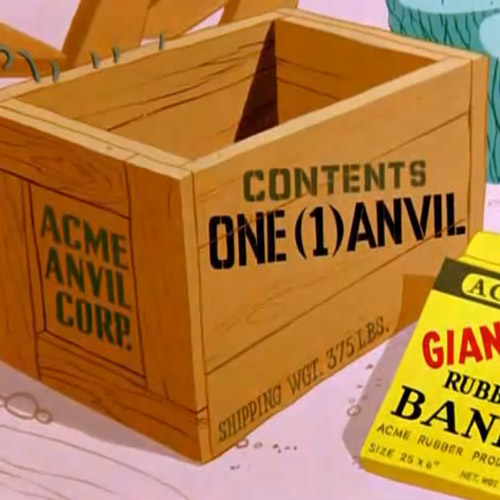
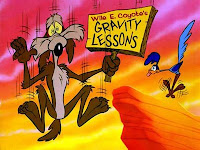
Incidentally, the Greek here for anvil (akmōn) has the same root as the word acme (meaning summit or peak); a linguistic link serendipitously developed by Chuck Jones some two-and-a-half millennia after Hesiod.

John Milton was probably alluding to Hesiod’s cosmology when, in Paradise Lost, the Archangel Raphael tells of the rebel angels falling “nine days” from Heaven into Hell. Milton presumably imagined that a rebel angel would fall twice as fast as a bronze anvil: obviously he was unaware of Galileo’s then recent proposal that bodies falling in a vacuum will fall with uniform acceleration.

https://www.youtube.com/watch?v=gtdiHDxh3LU
Angel or anvil, nine days is an awful long time to be falling. Obviously it is a poetic trope, an expression of the metaphysical distance between the living and the dead, or the blessed and the damned. But to our post-Galilean and post-Newtonian (and post-Jonesian) world, it seems ridiculously exaggerated, not to say impossible. As a matter of interest, I tried to work out roughly how far away Hesiod’s Heaven and Hell might actually be if they were to be considered in terms of physical, rather than mythological cosmology: unfortunately, my brain very soon began to overheat, what with having to take into account the gravitational constant and all, so I gave up and am going to rely on this guy’s calculation of 65,800 kilometers.
In order to then get to Tartarus, the anvil must presumably fall through a hole in the Earth (diameter 12,742 km) and drop out the other side. Assuming it landed with a splash at the entrance to the River Acheron, in present–day Epirus, it would have popped out of the South Pacific antipode like a Trident missile and end up in Tartarus after travelling a further 53,058 km through space. Coincidentally (?), this is about the distance from Earth that a putative space elevator would have to extend in order for an object attached to it to achieve escape velocity.   
To confuse matters even further, Virgil (never one to allow Roman Epic to be outbid by the Greeks) claims that Tartarus is double this distance:

...tum Tartarus ipse
bis patet in praeceps tantum tenditque sub umbras
quantus ad aetherium caeli suspectus Olympum.

Aeneid VI 577-579

...Tartarus itself stretches down into darkness, twice the flying distance from heavenly Olympus.
Milton’s Tartarus is even trickier to locate. A curious blogger came to the conclusion that an angel falling for nine days to Earth would have to begin the drop somewhere on the far side of the Moon. Milton also tells us that Hell is:
…As far removed from God and light of Heaven
As from the centre thrice to th' utmost pole.
At first glance this would seem to suggest that the distance from Heaven to Hell is three times the radius of the Earth, or 19,113 km. This would imply that a rebel angel falls at 88.4 kph, which is coincidentally (?) just on the legal side of the average speed limit on the real road to Hell*. So not really very rebellious after all. Such calculations assume that Hell, as in the classical tradition, is somewhere under the Earth’s crust. But in Paradise Lost, the banishment of the rebel angels to Hell precedes the creation of Earth: their “dungeon horrible” therefore cannot be terrestrial and subterranean. Nevertheless, Milton’s pole and centre probably refer to the distance from the Earth’s pole to the centre of Heaven.
Blake: Casting the Rebel Angels into Hell
So Milton follows, and trumps, the classical writers: in a sort of poetic grade inflation, Hesiod locates Tartarus the same distance as Heaven is to Earth; Virgil goes with twice that distance; and Milton three times as far.
Our classical tourists in the Underworld, Odysseus and Aeneas, have slightly different takes on the geography of the home of the damned. In the Odyssey, Tartarus seems to be open-plan in the style of Camp X-Ray: from his rocky viewpoint, Odysseus can observe the torment of various hubristic ne’er-do-wells:
·       Tityos the giant (condemned to Tartarus for the attempted rape of Apollo’s mother): he is stretched out on the ground and his liver is eternally pecked by a pair of vultures.
·       Tantalus (food issues: he killed and cooked his own son, then tried to serve Junior to the gods at a banquet): he is eternally thirsty and hungry; he stands in a stream beneath a fruit tree, but is prevented from consuming either.
·       Sisyphus (generally taking the piss out of the gods, but in particular chaining up Death with the consequence that nobody could die): sentenced to endlessly roll a stone up a hill, only to see it roll back down again from the top.
Sisyphus, Ixion and Tantalus
The Aeneid, as always, has to be a bit more ornate: Tartarus has triple walls, a massive iron tower and a gate made of toughened steel. Aeneas can hear the howls of anguish and the crack of the lash, but is not permitted to enter to see for himself. Luckily, his companion, The Sibyl, has previously had a guided tour and fills our hero in on the various villains within. It is of course a longer list than Homer managed, and includes in addition to the usual suspects the hubristic ingrate Ixion.
Ixion, king of the Lapiths in Thessaly, was a thoroughly bad lot. According to Pindar (Pythian Odes 2) and other sources, he was the first human to kill his own relative (having murdered his father-in-law in a dispute about money). He was shunned by all mankind for this crime, but Zeus took pity on him and brought him home to Olympus. Ixion repaid the Zeus’ uncharacteristic good deed by trying to seduce his wife, Hera. When the god found out about this, he decided to deceive the deceiver by making a 3D model of Hera from a passing cloud: Ixion promptly did the deed with this blow-up doll named Nephele, then boasted of his supposed success with the goddess.
Rubens: Ixion and Nephele
In punishment for this egregious breach of houseguest etiquette, Ixion was bound to an eternally-revolving wheel of fire and dumped in Tartarus. In an odd postscript, the nebulous sex-toy gave birth to the race of the centaurs, half human and half horse.
In the Aeneid, the Sibyl’s description of Ixion’s punishment is a bit puzzling: she describes Ixion seated nervously beneath a tottering rock; there is a banquet spread before him, but he is unable to reach it because of a menacing Fury. This is the punishment associated with Tantalus: almost all other sources (including Virgil himself in the Georgics IV 484) have Ixion on a wheel. One commentator has explained the discrepancy away by suggesting that the Sibyl is giving an impressionistic description of the scene,  “a confused sense of terrors inextricably blended,” but this seems a bit like special pleading. Perhaps even Virgil, like Homer, nods occasionally.
More about the ungrateful Ixion in the next post.
* Correction: the E6 now bypasses Hell and goes straight to Trondheim airport.

Saturday, 12 March 2016

Day Trips to the Underworld


This week saw the posthumous publication of Nobel laureate Seamus Heaney’s poetic translation of Virgil’s Aeneid Book VI, long considered one of the highlights of the Roman epic poem. Book VI is the pivotal point of the Aeneid:  Trojan hero Aeneas, having fled the destruction of the city, has been wandering the Mediterranean in search of a new home; in the sixth book he descends to the underworld, where his father’s ghost shows him a vision of the future Roman empire. For the next six books of the poem, Aeneas will fight to establish a home in Italy.
This wasn’t the first time that Heaney had taken inspiration from Virgil: in his poem Route 110 Heaney buys a copy of Aeneid VI in a second-hand book shop, and goes on a bus journey from Belfast through “an age of ghosts.” Artists have of course been addressing the problem of the afterlife for centuries, and the concept of a land of the dead is probably as old as humanity. In classical literature, the first poetic katabasis, or journey to the Underworld, is to be found in Homer’s Odyssey.
Odysseus tempts a ghost with some dead sheep
In Book XI, Odysseus attempts to get information about how to return to get back home to Ithaca by performing the gruesome rite of nekyia (ἡ νέκυια). This was a form of ghost-bothering which involves digging a trench and sacrificing some sheep. The anaemic spirits are attracted to ovine blood, and surround the trench hoping for a taste. Odysseus offers a drink to any spook he wishes to engage in conversation; the hangers-on are chased away at the point of his sword.
Around 700 years after Homer, Virgil composed the Aeneid, the great Roman foundation epic; he appropriated, in hommage or theft, much of the Homeric action, including a katabasis.
But when Aeneas visits his late father Anchises in the Virgilian Underworld, it’s all a bit more complicated (and civilised): rather than dragging his old man from his resting place to lick gore from a hole in the ground, like a good son (pius Aeneas) he does what Anchises providently told him to do and engages the wise Sibyl as his guide.
Turner's The Golden Bough
She tells him he needs to find a golden bough in the forest, and then points him in the direction of the river Acheron (rather than the Styx, which is merely a tributary). He will then have to cross over on the ferry of the god Charon.
Charon is a psychopomp, a god or spirit who guides the recently deceased to the Underworld: he was to the Greco-roman mythology what Anubis was to the Egyptians; what the Valkyries were to the Norse peoples; and what the Grim Reaper was to Bill and Ted.
Virgil characterises Charon as a grumpy ticket collector with poor personal hygiene:
Michelangelo's Charon
…cui plurima mento/ canities inculta iacet; stant lumina flamma/ sordidus ex umeris nodo dependet amictus. (A.vi. 299-301)
A scraggy grey beard on his chin, staring fiery eyes, stained and knotted cloak hanging from his shoulders.

You can’t get on my boat unless you’re dead and buried, he says. Had that Hercules in the back once, never again. Tried to steal our bleeding dog.
There’s little doubt that Virgil is having a laugh here, despite the grim subject matter; or, rather, because of the grim subject matter: since time immemorial we have had a tendency to attempt to cope with fear of death and its unknowable aftermath by reductive anthropomorphosis. See, for example, Death represented in Family Guy as a sarcastic misanthrope with issues.
Anyway, the jobsworth ferryman’s mood is assuaged on the production of a golden bough from a magic tree, which acts as Aeneas’ return ticket: normally, only singles were available, the fare being generally believed to be one obol. For this reason ancient funeral rites required the placing of a coin in the mouth of the deceased: those unfortunates who did not have the fare, and/or had not received a proper burial, were condemned to haunt the near side of the river for a century:
Stabant orantes primi transmittere cursum / tendebantque manus ripae ulterioris amore/ navita sed tristis nunc hos nunc accipit illos / ast alios longe submotos arcet harena (A.vi. 313-316)
All stood begging to begin their crossing, reaching out hands in longing for the further shore; the grim ferryman takes on this one and that, but chases others away from the sands.
One of these unfortunate ghosts is Palinurus, Aeneas’ trusted helmsman who had fallen overboard while on duty. He begs Aeneas to give him a lift on Charon’s ferry, but is firmly told by the Sibyl that rules is rules. This is a pathetic scene: we cannot help but compare and contrast the helplessness of brave Palinurus, who once controlled an ocean-going ship, with the power of the scruffy Charon, who pilots his tub across a muddy pond.
You’re either on the boat or you’re off the boat; you’re either on the way to the far shore or you’re left kicking your heels on this side: such is the duality explored in Don Paterson’s poem The Ferryman’s Arms, which transfers Charon’s barge to Scotland today. Like Heaney’s Route 110 bus, Paterson’s journey to the land of the dead is by public transport: we all have to stick to the timetable. The narrator is early, and has ten minutes to kill (sic) in the eponymous pub prior to embarking on the ferry. He buys a Guinness (black and white – duality again) and is “drawn, like a moth” to the light of a pool table in the darkened back room.
Dali's Charon
He decides on a whim to play against himself: I took myself on for the hell of it. Slotting / a coin in the tongue of the table, I looked round for a cue. (Paterson’s language more than hints at where we are: hell; the allusion to the coin in the mouth; the pun on cue/queue reminding us of the line of souls awaiting the ferryman). He makes an immaculate clearance of the balls, as the black / did the vanishing trick while the white stopped. It is a small miracle that seems to call into question the laws of physics.
He then watches the ferry arrive, from somewhere unspeakable; like a ghost ship, it hardly disturbs the black water. The narrator (or half of him) gets on board, leaving his imaginary opponent sullenly / Knocking the balls in, for practice, for next time.
Although the ferryman is unseen and unheard in the poem (as is the barman, who has presumably poured the narrator’s Guinness), he permeates it: the poet is always on Charon’s territory, either in the Ferryman’s Arms, or on board the ferryman’s boat. The pointed lack of description of other people suggests that the poet is experiencing a sort of existential loneliness: but you’re never alone with a split personality, a trope so common in Scottish literature and culture (Jekyll and Hyde, Highland and Lowlands, Protestant and Catholic, Yes and No) that the term Caledonian Antisyzygy had to be invented to identify it. Hugh MacDiarmid, who literally wrote the book on the subject, was also Chris Grieve.
At the end of the poem, the narrator is both winner and loser, on the boat and off the boat, alive and dead: like Schrödinger’s cat. As he has already noted in the Ferryman’s Arms, “physics itself becomes something negotiable”.
Paradoxically it is the winner who boards Charon’s ferry, leaving the loser to the tedium of his existence until “next time”. On the face of it, this detail could admit a nihilist interpretation, that death is not only inevitable, but preferable to a meaningless existence; however, in my own view, the “next time” implies a future re-match, a re-uniting of the dual personalities; that the passenger to the other world not only had an obol to get there, but a golden bough to return; and that like Aeneas and Odysseus, he would return from his encounter with the Dead wiser and forever changed.

Thursday, 3 March 2016

Quem vocabis? Ghostbusting in Elsinore


It is literally Baltic tonight.  Fingers of sea mist climb the battlements and leave wet salt prints on the stone. A bare bodkin of wind pierces your cloak and presses its point against your quivering flesh. There’s no moon and as you look up at the one bright star you-ouch- stub your toe on something in the darkness.  You wish you were back in your bed under a warm sheepskin. And that’s where you were, dreaming of Wittenberg fräuleins, until just before midnight, when Marcellus shook you awake and reminded you that you said you would come out and join the night watch in case it appeared again. It’s just imagination, you had told him, but he kept going on and on about it, no no, we definitely saw it, and not just once but twice. Please, Marcellus had begged, we need an educated man, someone who’ll be able talk to it.  You had smiled at that, but with the dodgy state of Denmark presently, it was probably a good idea to keep in the good books of the military. So now here you were, frozen to the nuts on a wild ghost chase. What a way to pay off your student loan…
Who you gonna call?

In Hamlet’s opening scene, Shakespeare invented the horror movie. We begin literally and figuratively in the dark, in ominous silence - not a mouse stirring, sharing the loneliness and fear of a nervous guard, Francisco. The tension is broken by the appearance of his relief. Francisco is only too pleased to hand over to his officer Bernardo: ‘tis bitter cold and I am sick at heart he says, blurting out a hint of the terror he has endured, alone in this haunted place.

Luckily for Bernardo, he has company:  his fellow officer Marcellus, who has brought along insurance in the form of our reluctant hero, Horatio. For when there’s something strange in the neighbourhood of Elsinore, who you gonna call but an alumnus of the University of Wittenberg? Even though Horatio is sceptical about the existence of the Ghost, Marcellus wants him there, that if again this apparition come/ He may approve our eyes and speak to it. Why do they need Horatio in particular to do this? Because he has studied Latin, the lingua franca of spooks, spectres and most other supernatural beings. When the Ghost appears, Marcellus commands: Thou art a scholar; speak to it, Horatio...

Now, such is the precarious position of classical languages in schools and universities today that we would struggle to find a student capable of engaging with a revenant on a castle battlement. Indeed, the modern youth’s exposure to the Latin language is likely to be confined to a few semi-latinate spells in a Harry Potter novel (lumos maxima, indeed: you would have thought that she could afford proper Latin)

To be fair, there is a long history of Latin muddle before the Muggles. The conjuror’s phrase hocus pocus is probably derived from hoc est corpus meum of the Latin Mass, the words mangled either accidentally through ignorance, or deliberately in Protestant mockery of the Roman Catholic belief in transubstantiation.

Whether practising wizardry, turning bread into flesh or pulling rabbits from hats, Latin has been the traditional go-to tongue, at least in the western imagination. Until the vernacular reforms of the Second Vatican Council in the early 1960s, it was, for some, the only respectable medium of communication with God: the Good Lord is now apparently capable of understanding English these days, however. Some authorities still believe that the judicious deployment of a few words of Latin will get His attention, in the way that a Parisian waiter will deign to notice you only if you address him respectfully en francais; thus President Jed Bartlet, in the West Wing episode Two Cathedrals, unable to discern God’s purpose in permitting the innocent to suffer, tells Him to go to hell in Latin (eas in crucem literally means get on a cross, something of a sore point with the Almighty, one would have thought).

As with God, so with the Devil. In Doctor Faustus, Christopher Marlowe has the eponymous alchemist conjure up Mephistophilis with a blood-curdling Latin incantation: …Orientis princeps Belzebub inferni ardentis monarcha, et Demogorgon, propitiamus vos, ut appereat, et surgat Mephostophilis… (now that is a proper spell, Ms Rowling).

The precise meaning of all this Prince of the East, monarch of hellfire stuff would be comprehensible to only a tiny fraction of the audience; but all could buy into the idea that magical power was associated with the study of arcane texts – after all, hadn’t those Latin-speaking, Bible-reading priests been able to turn wine into blood and bread into flesh?

The old word for this sort of magic or occult knowledge was gramarye, which is of course derived from the same root as grammar, meaning the nuts and bolts of a language, or the book you can learn it from. Etymological digression -the word glamour is another variant of this root, and presumably gets its present meaning from the idea that magic can be used to enthral or bewitch others, that spells can dazzle the eyes of the beholder. A Glam Rocker, therefore, is etymologically a cousin of a grammarian.
Goodnight sweet prince...

It is gramarye that Potter is studying at Hogwarts, and that Bartlet employs to address his God. Gramarye is used by Faustus as a way to connect with the supernatural, a portal through which he can negotiate a deal with Lucifer for 24 years of fun-filled life in return for his soul. Despite the fact that he gets to snog Helen of Troy, this is generally considered to be a poor exchange: Faustus has wasted his knowledge on trifles. Horatio uses his learning more fruitfully, attempting to engage with the apparition to determine why it is walking the earth – does it have a message about dangers facing Denmark, by any chance? But Horatio has been dragged out of bed not only because he can use his Latin grammar to connect with the supernatural; he can also use it to disconnect. Marcellus knows that if anything goes wrong with the ghostly interaction, his scholar companion will have the wherewithal to carry out an old-fashioned Catholic exorcism.

Thus the first Act Ghost scenes of Hamlet set up a problem which will recur throughout the play, and which offers us an insight into Shakespeare’s England, where state and personal religion was still in a state of flux following the Reformation: Horatio is a sceptic, and studies at Wittenberg, a university with deep Protestant associations; when the Ghost speaks to Hamlet, it describes its torment in Purgatory, a Catholic concept rejected as unbiblical by the Reformers. Since there was no Purgatory in Protestant theology, it followed that there were no ghosts: therefore anything that presented itself as a ghost was probably a devil in disguise. The tragedy of Hamlet stems from the Prince’s inability to decide whether what he has seen is an honest ghost (I,v,138) or a devil assuming a pleasing shape (II,ii,574). Hamlet and Horatio, torn between Catholic and Protestant interpretations of their ghostly encounters in Elsinore, reflect the religious tensions racking Tudor England, and perhaps Shakespeare himself.