About this blog...

Showing posts with label Homer. Show all posts

Thursday, 18 May 2017

Scones, Pizza, and an Epic Fail


Browsing the admirable @rogueclassicist Twitter feed recently, I was interested to read an extract from a cookbook, posted by US academic and classicist Angela Taraskiewicz.  And a remarkably erudite cookbook it was: its recipe for currant tea scones noted that the first written appearance of the word scone was in “an early sixteenth-century translation of the Aeneid  by the Scottish poet Gavin Douglas.”
Could this proto-scone be a Scots rendering of the phrase adorea liba in Aeneid book VII, Angela wondered? She was referring to lines 109-110 (adorea liba per herbam/subiciunt epulis), where the Trojans are having an outdoor meal and put these liba on the grass as platters for their various meats.
Gavin Douglas
According to C T Lewis’ Elementary Latin Dictionary, adoreum is the Latin for spelt; libum is a cake or pancake (C T also helpfully provides a recipe, recommending “flour, made up with oil or milk, and baked,” though he doesn't say for how long); and  Douglas does indeed translate the lines into Middle Scots thus:  
The flowr sconnys war set in, by and by/ With other mesis, sik as wer reddy...
It should be a matter of deep national pride for Scotland that the first complete translation of Virgil’s Aeneid done in the British Isles, and indeed in any Germanic language, was in Scots. Gavin Douglas, at the time Provost of the Church of St Giles, later Bishop of Dunkeld, composed it at the behest of his patron, Henry, 3rd Lord Sinclair; it was completed in 1513, which turned out to be an interesting year for both men.
A flavour of Douglas’ translation may be had from the epic's famous opening lines:
The batalis and the man I wil discrive / Fra Troys boundis first that fugitive/ By fait to Ytail come and cost Lavine/ Owr land and sey kachit with mekil pyne/ By fors of goddis abufe, from euery steid/ Of cruell Juno throu ald remembrit fede.                                                                                                                                                 
Even if it may be argued there are better translations per se, Douglas’ Eneados has a case to be considered the most vigorous, vital and, well, fun rendition of the epic poem: not only does it have scones, but it also includes the first written occurence of the exclamation Wow! 
 
But let us to return to our scones, and their crucial role in the narrative structure of the Aeneid. As we have seen, they appear early in Book VII, when the Trojans are celebrating landfall in Italy: for the first six books, which are Virgil’s hommage to Homer’s Odyssey, Aeneas has been wandering the Mediterranean in search of a new home, even going so far as to visit the Underworld for help; the remainder of the work will follow the Iliad in describing a land war and battle of champions. An apparently insignificant joke about dough becomes the fulcrum upon which are balanced the Odyssean and Iliadic halves of the Aeneid.
Back in Book III, Aeneas and his refugees from Troy land on the Strophades, in the Ionian Sea. They are delighted to see that the island is populated with tasty-looking livestock, and set about barbecuing a few. Unfortunately, the island is also home to the Harpies, monstrous birds of prey with a female human face. Like hungry seagulls spying a chip wrapper, they descend upon the Trojans’ lunch and then generally crap all over the picnic. Aeneas tells his men to gather all the gear up, and they move elsewhere; no sooner do they get the charcoal alight again, when the dread creatures return. This time the hungry Trojans fight back, chasing them off with sword and shield.
The head Harpy, Celaeno (a drery prophetes, says Douglas) perches on a rock and somewhat huffily addresses the Trojans:  "So you’re willing to fight us over stolen meat? You try to drive us innocent Harpies from our own home? Well hear this: you may reach Italy, but you will never have your own city until you have suffered such starvation that you will chew your own tables.” And with that, the feathered femme fatale flies off. This curse puts a bit of a crimp on the party, and the Trojans make sail from the Strophades without delay.
A deep-fried half-pizza supper
The pay-off to this tale comes four books later. On arrival in Latium, the Trojans celebrate with an outdoor feast in honour of Jupiter: as we have seen, they place thin scones on the grass and heap meat and wild fruits on top. I have very fond memories of this scene: way back in the early 70s, halcyon era of glam rock and the orange Cambridge Latin Course, my esteemed Classics teacher, Mr Lennox, describing the Trojan outdoor cuisine, informed us that this sort of thing was eaten to this very day in Italy, and it was called a pizza: he had been to Naples and had actually seen one with his own eyes. Now as it happened, we were already aware of the concept, since Pieroni’s, the local chip emporium, had recently introduced us to the half-pizza supper, a semi-circular lump of tomato puree-smeared dough, deep-fried in chip fat, doused in salt and vinegar and wrapped in the pages of the Irvine Herald. So we could in fact well imagine the pleasure the hungry Trojans took from their pepperoni feast.
Having scoffed the toppings, the Trojans are still hungry, and set about eating the crusty square base: Ne spair thai not at last, for lak of meat/ Thar fatal four-nukit trynschour for to eyt. Ascanius, Aeneas’ young son, blurts out a joke: “Heus! etiam mensas consumimus”
 “Och!” quod Ascanius, “how is this befall?/ Behald, we eyt our tabillis up and all!”
Now, this is a beautiful little narrative set-up and pay-off that signals the turning point of the Aeneid. The wandering is at an end; but the war for a homeland is yet to begin. The scene is full of wit, charm and dramatic irony, as the audience enjoys Virgil’s call-back to the curse of Celaeno, the Harpy-in-Chief: that the price of a home would be desperate starvation. We are relieved that such a dire curse is dispelled so painlessly; we are amused that the mask of tragedy has unexpectedly been turned to a smiley face; we are delighted that an evil omen is defeated by a child’s innocent remark that they had been so hungry that they had eaten their tables.
Except that Virgil, apparently, seems to have forgotten all about the blood-curdling Harpy prophecy in Book IV; instead, he gives Aeneas a portentous aria: Hail, land promised by fate and hail, to you, trusty gods of Troy! Here is our home, here is our own country! Aeneas then explains at length that his father Anchises had told him that all this would happen. He even quotes his dad verbatim: Son, when you’re in a strange land and you get so hungry that you devour your own tables:
Ramembir, in that place, or near fast by/ To found thy first cite with thi hand.
One can imagine this fairly obvious error in the storyline puzzling not only to the Trojan veterans of the Strophades adventure; but also the more attentive of the real-life audience. It is, literally, Virgil's epic fail.
Trojan picnic
How to explain such an egregious continuity error? I suppose it’s possible that he could simply have forgotten, over the course of composing four books-worth of hexameter verse, that the original comment was made by Celaeno. Possible, but highly unlikely: the pizza/scone/table incident is a watershed in the poem, and Virgil had taken the trouble to establish its significance.
A more likely explanation is that Virgil changed his mind mid-composition, but died before he was able to make the consequential amendments elsewhere in the work. According to his biographer Donatus, Virgil’s dissatisfaction with the incomplete work was such that he ordered the poem to be destroyed after his death. Augustus himself countermanded the instruction and had it published. Doubtless the emperor was a genuine poetry lover; but the Aeneid also had powerful propaganda value to the ruling Julian regime.
The pizza/scone incident is sandwiched (sorry) between two other big set-pieces: the procession of future Roman heroes in Book VI, and the description of the scenes from future Roman history on Vulcan’s shield in Book VIII.
In Book VI, Aeneas’ visit to the underworld culminates in his late father Anchises showing him a long queue of noble souls who have undergone a sort of Platonic metempsychosis and are awaiting reincarnation as future Romans. Chief among them are members of the Julian dynasty: Augustus Caesar, his adoptive father Julius Caesar; and his nephew and prospective heir, Marcellus. Of divine heritage, they will restore a golden age to Rome:
Cum of the goddys geneology and kyn/ Quhilk sall agane the goldin warld begyn.
Anchises also sets out his famous mission statement for Rome, a sort of ethical genocide policy: parcere subjectis, et debellare superbos: spare the defeated and destroy the proud in war.
Aeneas’ mother, the goddess Venus, also has something to contribute regarding her descendants’ role in Roman greatness. In Book VIII she brings him armour and a shield, on which are engraved depictions of the most significant events in future Roman history. Forty lines suffice to cover from the time of Romulus to the Catilinarian conspiracy; no fewer than fifty-eight are devoted to the Battle of Actium and Octavian/Augustus’ triumph over Mark Antony and Cleopatra, thus confirming him as sole ruler of the Empire.
Having so deliberately highlighted Rome’s destiny, and identified the current imperial family with the hero Aeneas and the gods themselves, Virgil perhaps reconsidered the source of the prophecy associated with the establishment of the city.  Rather than allow the foundation of Rome to be heralded by a birdwoman of ill omen -almost an obscene parody of the Roman eagle- the messenger becomes father Anchises and, by some unexplained logic, Jupiter himself. Virgil, or perhaps his political masters, decided Rome should have a more exalted foundation myth.
You lookin' at me, Antony?
There is however a third possibility: one modern school of thought perceives an anti-Augustan and anti-imperialist line concealed within the poem, and interprets the contradictions and continuity errors as indications of this alternative Virgilian “personal” narrative as opposed to the “official” state propaganda narrative. In this analysis, Virgil at times deliberately paints an unattractive portrait of Aeneas, and by association, Augustus: Aeneas’ human sacrifice of Latin prisoners of war, and the vindictive slaughter of his enemy Turnus are coded criticisms of Augustus’ behaviour in the Civil Wars. This killing, the final brutal act of the entire epic, leaves snowflakes such as myself with seriously ambiguous feelings towards the hero we have sailed and fought with for twelve long books. The death of the helpless Turnus undermines the poet’s mission statement for Rome: the arrogant opponent has been vanquished, but the defeated enemy has certainly not been spared.
There can be no doubt that the Aeneid ends on a rather sour note.
The spreit of lyfe fled murnand with a grane/ And with disdeyn vnder dyrk erth is gayn.
 But it's a bit of a stretch to say that this proves that Virgil was a sort of literary fifth-columnist within the Principate. The very attractiveness of the theory should give us pause, lest wishful thinking persuade us that Virgil mirrors our own 21st Century liberal mores. Perhaps, in his depiction of the liquidation of Turnus, Virgil was trying to make a point about dictatorship and the violent suppression of opposition; on the other hand, he may simply have been anticipating Lenin's apocryphal line about omelettes and eggs. We'll never know.
Aeneas and a war crime.

More about Douglas' translation, in the context of the year 1513, next time.


Monday, 16 May 2016

Some kind of terrible, terrible fall


As discussed in the previous post, Greek and Roman religious belief was that the dead inhabited an underground kingdom, overseen by various chthonic deities such as Hades, Persephone and Charon. Unlike the Judaeo-Christian tradition of a subterranean Hell dedicated to the punishment of sinners (aka the burny fires, as my Presbyterian mum pleonastically called it), the classical Underworld was the final destination of us all, good and bad, just and unjust.
Punishment was certainly available for those who merited it, however; and it was meted out in the place called Tartarus. According to Hesiod’s Theogony (8th or 7th Century BCE), Tartarus (originally created by the gods as a prison for the troublesome Titans) is situated as far beneath us as we are beneath heaven:
τόσσον ἔνερθ᾽ ὑπὸ γῆς, ὅσον οὐρανός ἐστ᾽ ἀπὸ γαίης:
τόσσον γάρ τ᾽ ἀπὸ γῆς ἐς Τάρταρον ἠερόεντα.
ἐννέα γὰρ νύκτας τε καὶ ἤματα χάλκεος ἄκμων
οὐρανόθεν κατιὼν δεκάτῃ κ᾽ ἐς γαῖαν ἵκοιτο:
ἐννέα δ᾽ αὖ νύκτας τε καὶ ἤματα χάλκεος ἄκμων
ἐκ γαίης κατιὼν δεκάτῃ κ᾽ ἐς Τάρταρον ἵκοι.
Hesiod, Theogony 721-725
…as far beneath the earth as heaven is above earth; for so far is it from earth to Tartarus. For a bronze anvil falling down from heaven nine nights and days would reach the earth upon the tenth: and again, a bronze anvil falling from earth nine nights and days would reach Tartarus upon the tenth.
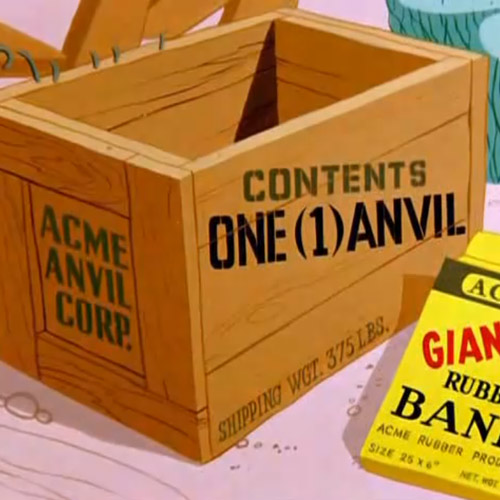
Incidentally, the Greek here for anvil (akmōn) has the same root as the word acme (meaning summit or peak); a linguistic link serendipitously developed by Chuck Jones some two-and-a-half millennia after Hesiod.

John Milton was probably alluding to Hesiod’s cosmology when, in Paradise Lost, the Archangel Raphael tells of the rebel angels falling “nine days” from Heaven into Hell. Milton presumably imagined that a rebel angel would fall twice as fast as a bronze anvil: obviously he was unaware of Galileo’s then recent proposal that bodies falling in a vacuum will fall with uniform acceleration.

https://www.youtube.com/watch?v=gtdiHDxh3LU
Angel or anvil, nine days is an awful long time to be falling. Obviously it is a poetic trope, an expression of the metaphysical distance between the living and the dead, or the blessed and the damned. But to our post-Galilean and post-Newtonian (and post-Jonesian) world, it seems ridiculously exaggerated, not to say impossible. As a matter of interest, I tried to work out roughly how far away Hesiod’s Heaven and Hell might actually be if they were to be considered in terms of physical, rather than mythological cosmology: unfortunately, my brain very soon began to overheat, what with having to take into account the gravitational constant and all, so I gave up and am going to rely on this guy’s calculation of 65,800 kilometers.
In order to then get to Tartarus, the anvil must presumably fall through a hole in the Earth (diameter 12,742 km) and drop out the other side. Assuming it landed with a splash at the entrance to the River Acheron, in present–day Epirus, it would have popped out of the South Pacific antipode like a Trident missile and end up in Tartarus after travelling a further 53,058 km through space. Coincidentally (?), this is about the distance from Earth that a putative space elevator would have to extend in order for an object attached to it to achieve escape velocity.   
To confuse matters even further, Virgil (never one to allow Roman Epic to be outbid by the Greeks) claims that Tartarus is double this distance:

...tum Tartarus ipse
bis patet in praeceps tantum tenditque sub umbras
quantus ad aetherium caeli suspectus Olympum.

Aeneid VI 577-579

...Tartarus itself stretches down into darkness, twice the flying distance from heavenly Olympus.
Milton’s Tartarus is even trickier to locate. A curious blogger came to the conclusion that an angel falling for nine days to Earth would have to begin the drop somewhere on the far side of the Moon. Milton also tells us that Hell is:
…As far removed from God and light of Heaven
As from the centre thrice to th' utmost pole.
At first glance this would seem to suggest that the distance from Heaven to Hell is three times the radius of the Earth, or 19,113 km. This would imply that a rebel angel falls at 88.4 kph, which is coincidentally (?) just on the legal side of the average speed limit on the real road to Hell*. So not really very rebellious after all. Such calculations assume that Hell, as in the classical tradition, is somewhere under the Earth’s crust. But in Paradise Lost, the banishment of the rebel angels to Hell precedes the creation of Earth: their “dungeon horrible” therefore cannot be terrestrial and subterranean. Nevertheless, Milton’s pole and centre probably refer to the distance from the Earth’s pole to the centre of Heaven.
Blake: Casting the Rebel Angels into Hell
So Milton follows, and trumps, the classical writers: in a sort of poetic grade inflation, Hesiod locates Tartarus the same distance as Heaven is to Earth; Virgil goes with twice that distance; and Milton three times as far.
Our classical tourists in the Underworld, Odysseus and Aeneas, have slightly different takes on the geography of the home of the damned. In the Odyssey, Tartarus seems to be open-plan in the style of Camp X-Ray: from his rocky viewpoint, Odysseus can observe the torment of various hubristic ne’er-do-wells:
·       Tityos the giant (condemned to Tartarus for the attempted rape of Apollo’s mother): he is stretched out on the ground and his liver is eternally pecked by a pair of vultures.
·       Tantalus (food issues: he killed and cooked his own son, then tried to serve Junior to the gods at a banquet): he is eternally thirsty and hungry; he stands in a stream beneath a fruit tree, but is prevented from consuming either.
·       Sisyphus (generally taking the piss out of the gods, but in particular chaining up Death with the consequence that nobody could die): sentenced to endlessly roll a stone up a hill, only to see it roll back down again from the top.
Sisyphus, Ixion and Tantalus
The Aeneid, as always, has to be a bit more ornate: Tartarus has triple walls, a massive iron tower and a gate made of toughened steel. Aeneas can hear the howls of anguish and the crack of the lash, but is not permitted to enter to see for himself. Luckily, his companion, The Sibyl, has previously had a guided tour and fills our hero in on the various villains within. It is of course a longer list than Homer managed, and includes in addition to the usual suspects the hubristic ingrate Ixion.
Ixion, king of the Lapiths in Thessaly, was a thoroughly bad lot. According to Pindar (Pythian Odes 2) and other sources, he was the first human to kill his own relative (having murdered his father-in-law in a dispute about money). He was shunned by all mankind for this crime, but Zeus took pity on him and brought him home to Olympus. Ixion repaid the Zeus’ uncharacteristic good deed by trying to seduce his wife, Hera. When the god found out about this, he decided to deceive the deceiver by making a 3D model of Hera from a passing cloud: Ixion promptly did the deed with this blow-up doll named Nephele, then boasted of his supposed success with the goddess.
Rubens: Ixion and Nephele
In punishment for this egregious breach of houseguest etiquette, Ixion was bound to an eternally-revolving wheel of fire and dumped in Tartarus. In an odd postscript, the nebulous sex-toy gave birth to the race of the centaurs, half human and half horse.
In the Aeneid, the Sibyl’s description of Ixion’s punishment is a bit puzzling: she describes Ixion seated nervously beneath a tottering rock; there is a banquet spread before him, but he is unable to reach it because of a menacing Fury. This is the punishment associated with Tantalus: almost all other sources (including Virgil himself in the Georgics IV 484) have Ixion on a wheel. One commentator has explained the discrepancy away by suggesting that the Sibyl is giving an impressionistic description of the scene,  “a confused sense of terrors inextricably blended,” but this seems a bit like special pleading. Perhaps even Virgil, like Homer, nods occasionally.
More about the ungrateful Ixion in the next post.
* Correction: the E6 now bypasses Hell and goes straight to Trondheim airport.